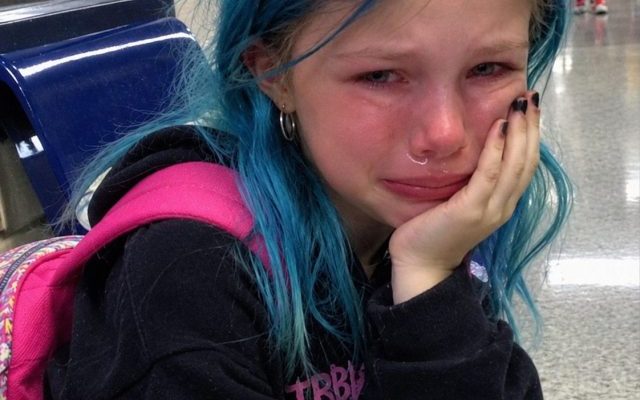
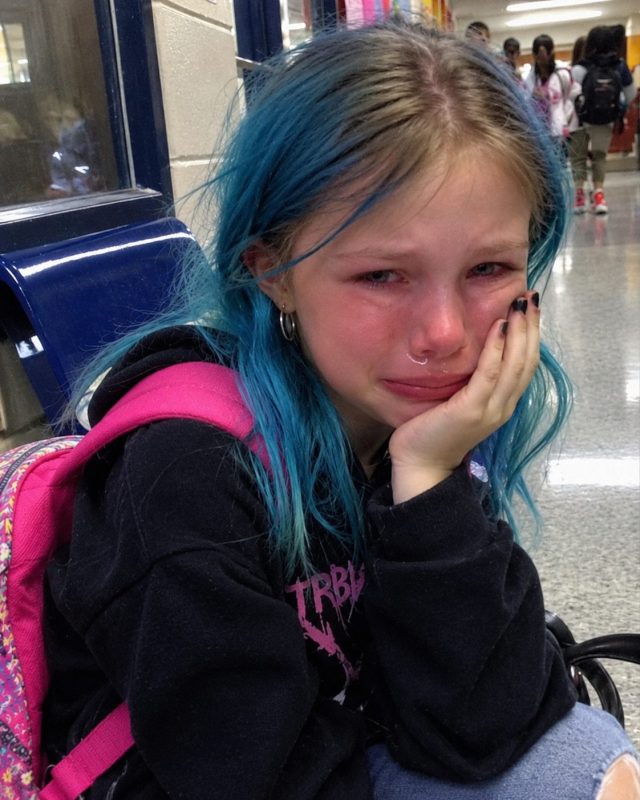
My Daughter Was Mocked for Her Blue Hair, but She Taught the Whole School a Lesson
Lily pointed at Mrs. Collins.
“She made me feel like monsters look like me.”
Mrs. Collins covered her mouth. “No, Lily. I didn’t say that.”
Lily’s voice trembled. “You didn’t stop them.”
The room went silent.
The principal, Mr. Hayes, held a folded sheet of paper. Across the top, in thick black marker, were the words:
“THINGS PEOPLE SAID ABOUT ME YESTERDAY.”
Below them was a list:
- Witch.
- Monster.
- Weirdo.
- Ugly.
And at the bottom:
Mrs. Collins: “Your appearance is becoming a distraction.”
I froze.
“Where did you get this?” I asked.
“I made it,” Lily replied.
Then I noticed her shirt. Under her denim jacket, she’d written every insult across the front.
On the back, in larger letters, were the words:
“IF THESE WORDS ARE DISTRACTING, WHY WEREN’T THE PEOPLE SAYING THEM?”
My name is Rachel, and Lily is my only child. I didn’t know whether to feel proud, angry, or terrified.
Probably all three.
I crouched beside her.
“Are you okay?”
She nodded, but I knew that didn’t mean much.
“Did anyone hurt you?”
“No.”
“Did you get in trouble?”
She glanced at Mrs. Collins.
“She told me to put my jacket back on.”
Mrs. Collins quickly explained that the words on Lily’s shirt were upsetting the other students.
I stared at her.
“Yesterday, those same words weren’t enough to remove the children saying them from class. But today, when Lily writes them on her shirt, suddenly they’re inappropriate?”
Mrs. Collins lowered her eyes.
“I handled yesterday badly.”
That surprised me.
She explained that she’d thought sending Lily out of the classroom would calm everyone down.
“You removed the child being bullied,” I said.
“I know.”
“And told her she was distracting.”
“I know.”
Then Mrs. Collins crouched in front of Lily.
“I was wrong. When the other children made comments about your hair, I should have stopped them.”
Lily looked at the floor.
“Tyler said, ‘See? Even Mrs. Collins thinks you look bad.'”
Mrs. Collins looked devastated.
“I didn’t know he said that.”
“You didn’t ask,” Lily whispered.
Nobody spoke.
I turned to the principal.
“Why was Lily sent to your office yesterday?”
To find out how the story continues, check the comments below. 👇👇👇
He explained that Mrs. Collins had sent her there because of a classroom disruption.
I asked whether Lily had broken any school rules.
“No,” he admitted.
“Then why was she the one being questioned? My daughter’s appearance isn’t a classroom disruption.”
He nodded.
“You’re right.”
That was when Lily explained what had happened.
She’d entered class wearing her jacket zipped up. Tyler, the same boy who had called her a witch the previous day, whispered something to another student, and a few children laughed.
Later, when Mrs. Collins asked everyone to remove their jackets because the classroom was warm, Lily asked if she had to.
When she finally took it off, everyone noticed her shirt.
Mrs. Collins immediately told her to cover it.
Lily pulled the paper from her sleeve and said:
“These words were appropriate yesterday.”
There had been no screaming or fighting. Just an eight-year-old standing in front of her classmates, showing everyone the insults adults had failed to stop.
I asked Lily why she hadn’t told me about the shirt.
“You were already mad,” she said.
“At you?”
“No. At them.”
I hugged her.
Then I asked why she’d painted her nails black again after the other children had called them ugly.
“Because they said they were ugly,” she answered.
That hurt more than anything.
She wasn’t simply expressing confidence. She was trying not to let other children decide who she could be.
The principal explained that four children had repeatedly made comments about her appearance. Their parents had been contacted, and the school planned restorative conversations with the counselor.
Tyler was moved away from Lily’s desk, and the class would have a lesson about teasing and judging people by their appearance.
I worried it might embarrass Lily.
“Just don’t make everyone stare at me,” she said.
Thankfully, the counselor handled it well. She didn’t ask Lily to stand in front of everyone or turn her into an example.
Instead, she wrote two sentences on the board:
“Someone is different.”
“Someone makes fun of that difference.”
Then she asked the class which action created the problem.
Most children understood.
Tyler argued that nobody would have said anything if Lily didn’t have blue hair.
The counselor replied, “If I laughed at you for needing glasses, would your eyes be the problem, or would my behavior be?”
Tyler went quiet.
That afternoon, Lily told me the counselor was “very scary.”
I laughed.
A few days later, Mrs. Collins called me.
She apologized again and admitted that she’d made assumptions about Lily before anything had happened.
She’d grown up believing colored hair meant rebellion and black nail polish meant trouble.
“I put adult meanings onto an eight-year-old,” she said.
“Yes,” I replied.
“And then I punished her for the reaction I expected.”
I appreciated that she didn’t make excuses.
The following morning, Lily asked if she could wear the shirt again.
I said no.
“You’ve made your point,” I explained. “And I don’t want you walking around school with the word ‘ugly’ written across your chest.”
She thought about it.
“Can I wear my jacket?”
“Of course.”
“Black nails?”
“Of course.”
“Blue hair?”
“That’s attached to you.”
She smiled.
At school, Tyler and his mother were waiting near the office. His mother introduced herself and apologized for what he’d said.
Tyler looked at the floor.
His mother encouraged him to speak properly.
“I’m sorry I called you a witch and a monster,” he mumbled.
Lily crossed her arms.
“Okay,” she replied.
She didn’t say she forgave him or that everything was fine. Just okay.
Then she asked him to apologize for calling blue stupid, too.
He did.
Over the following weeks, something unexpected happened. Other children became more comfortable expressing themselves.
One girl started wearing the glasses she’d previously hidden. A boy wore pink shoelaces, and another girl stopped covering a birthmark on her arm.
I didn’t want Lily’s experience turned into some story about a brave girl teaching everyone self-love.
She was eight years old. She simply liked blue.
But children notice what adults allow.
Once the school made it clear that being different wasn’t wrong, some of them seemed more comfortable being themselves.
Mrs. Collins changed, too.
A month later, the class celebrated their favorite colors. Lily wore blue, naturally.
Mrs. Collins arrived with a streak of washable purple in her hair.
Lily came home horrified.
“Mom, Mrs. Collins dyed her hair!”
“What’s wrong with purple?” I asked.
“It doesn’t match her.”
I smiled.
“So we’re judging people’s hair now?”
She rolled her eyes.
“You’re annoying.”
“Correct,” I replied.
Eventually, she admitted Mrs. Collins looked kind of cool.
I kept Lily’s shirt in a box with her school pictures and birthday cards. The writing has faded, but the message on the back is still clear:
“IF THESE WORDS ARE DISTRACTING, WHY WEREN’T THE PEOPLE SAYING THEM?”
I’ve thought about that sentence many times.
I went into the school expecting to find a villain. Instead, I found a teacher who had made a bad decision because of her assumptions, a principal who hadn’t understood the real problem, and children learning that cruelty isn’t acceptable.
Mrs. Collins never became Lily’s favorite teacher, but slowly, Lily learned to trust her again.
And that mattered.
Because the biggest problem hadn’t been the blue hair or the school incident.
It was that my daughter had started believing she needed to change her appearance to make other people comfortable.
Instead, she took every ugly word they’d said, put it where everyone could see it, and made the adults ask themselves an important question:
Was the blue hair really the distraction, or was it the cruelty directed at the girl wearing it?