The Secret My Son Kept From Me
For nearly two months, my seven-year-old son, Hunter, came out of school about twenty minutes late every Friday. He always had the same explanation: his teacher, Mrs. Carter, needed his help.
At first, I thought nothing of it. The first time, he said he had helped organize books. The following week, he claimed he had sorted classroom supplies. But by the fourth Friday, I began to wonder why a teacher would repeatedly keep my seven-year-old behind when the other children had already gone home.
“Does anyone else stay to help?” I asked him one evening.
Hunter shook his head. “Just me.”
“Do you enjoy helping Mrs. Carter?”
He stared at his shoes before answering, “It’s okay.”
Something about his hesitation unsettled me. So, the following Friday, I arrived at school twenty minutes earlier than usual.
The front office was almost empty. When I told the secretary I was there to collect Hunter, she looked confused.
“Mrs. Carter’s class was dismissed ten minutes ago,” she explained.
I frowned. “But she keeps Hunter after school every Friday.”
The secretary shook her head. “Mrs. Carter leaves early on Fridays. Her husband has physical therapy.”
My stomach tightened. I hurried down the hallway toward Hunter’s classroom, but it was empty. His backpack was gone, too.
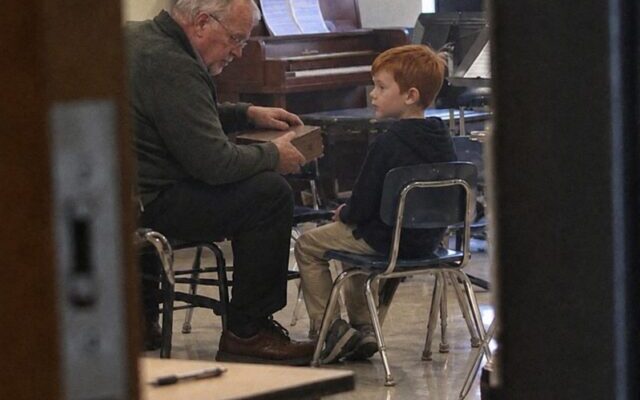
Then I heard his voice coming from the old music room, which was sometimes used for the school’s aftercare program.
I approached the slightly open door and peered inside.
Hunter was sitting across a table from a man I had never seen before. The stranger looked to be around sixty, and a cardboard box sat between them. Before I could step inside, the man slid something across the table.
Hunter whispered, “Mom said I’m not supposed to have that.”
The man leaned closer. “She doesn’t know you come here.”
My blood ran cold.
I pushed the door open. “Hunter!”
My son jumped in surprise. The man immediately stood up.
I rushed over and pulled Hunter behind me.
“Who are you?” I demanded.
The stranger raised his hands. “I’m not going to hurt him.”
“Then why are you alone with my son?”
Hunter tugged at my sleeve. “Mom, please.”
I ignored him and looked at the object on the table. It was a small red metal truck with a chipped wheel and faded pink paint across its hood.
I stopped breathing.
I recognized that truck immediately. Daniel, Hunter’s father, had bought it at a flea market when Hunter was two. I still remembered the photograph of my little boy sitting on our kitchen floor, holding the toy while Daniel made silly engine noises beside him.
Daniel had disappeared five years earlier, and the truck had vanished around the same time.
I had never seen it again.
“Where did you get that?” I whispered.
The man studied me for a moment before saying my name.
“Emily?”
I stepped backward. “How do you know my name?”
His eyes filled with emotion. “My name is Thomas. Daniel was my son.”
I let out a short, disbelieving laugh. “Daniel’s father is dead.”
“No,” Thomas replied quietly. “That’s what Daniel told you.”
Hunter picked up the truck. “He’s my grandpa.”
I turned toward my son, stunned. “You’ve been meeting him secretly?”
Thomas lowered his head. “Yes.”
“How did you find Hunter?”
“I didn’t,” he answered. “He found me.”
Hunter explained that his class had been assigned to make family trees. When he asked me about Daniel’s parents, I had told him they died before I met his father. But Hunter had discovered an old Christmas card in a box of Daniel’s belongings.
Inside, Daniel’s father had written: You don’t have to forgive me. But please don’t make your son grow up thinking I never wanted to know him.
To find out what happened next, check the comments below 👇👇👇

The card included an address.
Hunter had written Thomas a letter asking whether he was really his grandfather. He had even asked whether Thomas could write back if he was still alive.
I was angry that my son had been meeting a stranger without my knowledge, but my anger softened when Hunter confessed why he had kept the secret.
“Because you’d make him go away,” he whispered.
“Hunter, I wouldn’t do that.”
“You get sad whenever I ask about Dad.”
I opened my mouth, but no words came.
For five years, I had believed I was protecting Hunter by avoiding conversations about Daniel. I thought my silence spared him from my grief. Instead, my little boy had learned to hide his own feelings so he wouldn’t upset me.
I turned back to Thomas. “Why did Daniel tell me you were dead?”
Thomas explained that he and Daniel had fallen out years earlier. When Daniel was twenty, his father had insisted he finish college and join the family business. Daniel wanted a different life, and their argument ended with Thomas telling him never to come back if he walked out the door.
Daniel left, and their relationship remained broken.
“When he met you,” Thomas said, “I think it was easier for him to say I was dead than explain why he wanted me to be.”
Then I asked whether he and Daniel had ever reconciled.
Thomas hesitated before revealing a date I would never forget.
It was the day Daniel had left Hunter and me.
Three days earlier, Daniel had been restless, barely sleeping and taking phone calls outside. Then he packed a bag, kissed our sleeping son on the forehead, and walked out of our apartment. I never saw him again.
“That’s impossible,” I whispered.
Thomas shook his head. “He didn’t leave you the way you think.”
Daniel had returned to his father shortly before that night, desperately ill. He had been diagnosed with cancer and was terrified. After years of refusing to speak to Thomas, he had finally turned to him because he did not know how to face the possibility of dying.
“He told me he couldn’t go home and look at you and Hunter,” Thomas explained. “He couldn’t bear to tell you he might die.”
“So he ran away?” I asked bitterly.
“For three days,” Thomas admitted. “Then I told him he was about to make his own son spend his life wondering why his father had abandoned him.”
Daniel became angry, Thomas said, because he knew his father was right. He had intended to return home, but his condition deteriorated rapidly. The night before he planned to come back, he collapsed and was taken to the hospital.
He begged Thomas to contact me.
Our phone number had changed, so Daniel gave him my mother’s address and asked him to visit me personally.
“I went to the house,” Thomas said. “The small white one with the yellow front door and the rosebush beside the steps.”
I knew exactly which house he meant. I had lived with my mother then, and I would have remembered Thomas if he had visited.
“Who answered the door?” I asked.
“Your mother.”
Thomas explained that he had told her Daniel was dying and wanted to see me. But my mother had refused to let him speak to me. She believed Daniel had already caused enough pain and that I had finally begun rebuilding my life.
“She told me you didn’t want to see him,” Thomas said. “She thought she was protecting you.”
I could barely breathe.
For five years, I had believed Daniel had chosen to abandon us. Meanwhile, Daniel had died believing I knew he was sick and had refused to see him.
My mother had taken away the chance for us to say goodbye.
Thomas opened his box and showed me photographs of Hunter with his father, along with hospital keepsakes, birthday cards, and several envelopes bearing Hunter’s name. Daniel had written letters for his son’s fifth, sixth, seventh, and eighth birthdays, knowing he might not live to see them.
Thomas handed Hunter the letter marked seven.
With trembling hands, my son opened it and began to read.
“Buddy, if you’re reading this, I didn’t get enough time with you. I’m sorry for that. Please don’t ever mistake that for me not wanting it. There was nowhere I wanted to be more than home with you.”
Hunter pressed the letter against his chest and looked at me through his tears.
“Mom, Dad wanted me?”
I pulled him into my arms. “Yes, baby. He wanted you.”
That evening, I drove to my mother’s house. I asked her directly whether she had known about Daniel’s illness and whether Thomas had come looking for me.
At first, she defended herself. She said she had watched me suffer after Daniel disappeared and had wanted to protect me from more heartbreak.
“Protect me from saying goodbye?” I asked.
She looked away.
Then I asked whether Thomas had left anything for me. Her face crumpled, and she disappeared into her bedroom. When she returned, she was holding an envelope with my name written in Daniel’s familiar handwriting.
She had kept it for five years.
Inside, Daniel apologized for running away. He admitted he had been terrified, but he also explained that Thomas had made him understand how deeply his disappearance would hurt Hunter. Near the bottom of the letter, he had written four words:
I’m coming home.
He had intended to explain everything himself.
I sat in my car and cried, grieving not only the husband I had lost but also the goodbye that had been taken from me.
When I returned to Thomas’s house, Hunter was asleep on the couch, still holding the little red truck. Thomas stood as I entered.
“If you don’t want me to see him again, I’ll understand,” he said.
Hunter stirred awake and reached for his grandfather’s hand.
I looked at them and realized I had a choice. My mother had decided which truths I was allowed to know, believing she was protecting me. I would not make the same mistake with my son.
“No more secret Fridays,” I told Thomas. “If you want to see Hunter, you can come through the front door.”
Thomas covered his mouth, overwhelmed with emotion. Hunter smiled.
That night, I found my son playing with the red truck on his bedroom floor. I sat beside him, and he asked whether his father used to play cars with him.
“All the time,” I told him.
“Was he good?”
I laughed through my tears. “Terrible. He crashed everything.”
Hunter pushed the little truck toward me. “Show me.”
So I did.
For the first time in five years, I told my son stories about his father that weren’t about why he had left. We remembered the laughter, the silly games, and the little moments that had made Daniel a father who loved his child, even though he hadn’t been able to come home.
And for the first time, Hunter no longer had to wonder whether his father had wanted to stay.