I’d always wondered about the hole in our hallway wall. For nearly 30 years, no one would tell me how it got there. After my mother died, I finally learned the truth—and it was worse than I’d imagined.
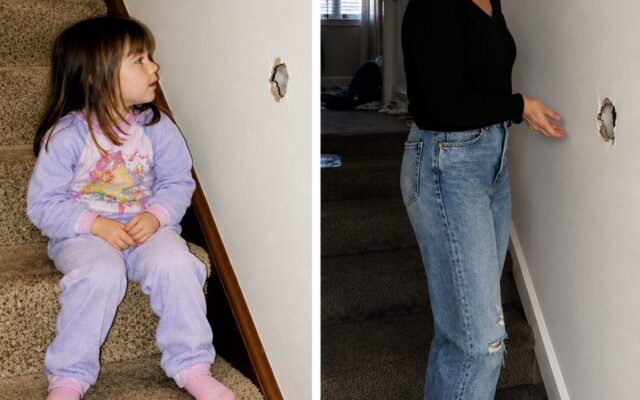
There was a fist-sized hole in the hallway wall of my parents’ house for almost 30 years.
Dad never patched it.
Mom never let anyone else patch it either.
That was strange because she repainted that hallway at least five times while I was growing up. She filled every nail hole, sanded every crack, and made the place look brand new.
But she always painted around that hole and covered it with the same wooden sign:
“HOME IS WHERE THE HEART IS.”
I must have walked past those words ten thousand times without knowing what my mother had hidden six inches behind them.
Dad wasn’t a monster. He worked construction, coached my brother’s baseball team, and made pancakes on Sundays.
But he had a temper, and that hole became something nobody talked about.
When I was 14, I asked Mom why she didn’t make Dad fix it.
“I’ve gotten used to it,” she said.
I never asked again.
Dad died six years ago.
Mom stayed in the house until she passed away this spring. My older brother, Michael, lived across the country and didn’t want the place, so it came to me.
While cleaning, I eventually reached the hallway.
I took down the wooden sign.
The hole was exactly as I remembered it.
Except this time, something caught my eye.
Blue plastic.
I grabbed a flashlight and saw a grocery bag wedged deep between the studs. It couldn’t have fallen there accidentally.
Inside were two more bags.
Then another.
When I opened the final one, I stopped breathing.
A gold watch sat inside a dark green velvet box.
I knew the name stamped on the lid.
Curated Timepieces & Jewelry.
Everyone in our neighborhood remembered that store. It had been burglarized when I was four. Thousands of dollars in watches, rings, and necklaces were stolen.
A teenager from our street had been blamed.
Benjamin.
Ben was 17 then, the same age as my brother.
Under the watch was a newspaper clipping:
“LOCAL TEEN CHARGED IN ‘CURATED TIMEPIECES & JEWELRY’ BURGLARY.”
Beneath it were handwritten notes from Mom.
June 14.
“She woke up when Michael came home.”
June 16.
“She keeps asking why Michael was crying.”
June 19.
“She said it again tonight.”
Then I read the sentence that made my stomach drop:
“She keeps saying Daddy put the boxes in the truck.”
I dropped the paper.
There was one more object inside the bag.
A small brass key.
I knew what it opened.
Dad’s old steel toolbox.
It had been locked throughout my childhood.
The key turned.
Inside were ordinary tools until I lifted the metal tray.
Underneath was a brown envelope with my name on it.
Inside was another newspaper clipping, a photograph of Dad’s old blue pickup, and a hand-drawn map of one of his construction sites.
A red X marked something labeled “DRAINAGE TRENCH 4.”
There was also a letter from Mom.
“If you’re reading this, your father and I are both gone. I’m sorry we left you with this.”
To find out what happens next, check out the comments below 👇👇👇

Then:
“Your father put the stolen jewelry in his truck.”
Something shifted inside my head.
A cardboard box.
One corner crushed.
Gold shining on the driveway.
Suddenly I was four years old again.
The porch light was on.
Michael was beside Dad’s truck, crying.
Dad was carrying boxes toward it.
Mom came running outside.
“What are you doing?” she’d shouted.
Michael saw me.
“Go back inside.”
But I kept staring at the open box near his feet.
Watches.
Velvet cases.
Gold chains.
Then Dad looked at Michael.
And I remembered what my brother had said:
“Go inside. I’ll take care of this.”
I called Michael.
“I found the bag.”
Silence.
“You know what I’m talking about.”
Another silence.
“Where are you?”
“At Mom’s.”
“Don’t call anyone.”
That was all I needed.
“You knew about the bag this entire time.”
“I can explain.”
“Did Dad rob Curated Timepieces & Jewelry?”
“No.”
“Then why did Dad have the jewelry?”
Michael started crying.
“I robbed the store.”
I couldn’t speak.
“I was 17. I took Dad’s truck. I thought I’d grab a few things and get out. Dad caught me when I came home.”
The memory clicked into place.
“Dad wasn’t protecting himself,” Michael whispered. “He was protecting me.”
“What did he do?”
“He took everything to North Ridge. He was supervising construction there that summer. He buried most of it in a steel container at the site.”
I looked at the map.
Drainage Trench 4.
“But they arrested Ben.”
“I know.”
“You knew he was innocent?”
“Yes.”
“Then why didn’t Dad come forward?”
“Because that would’ve meant giving me up.”
I hung up.
Then I went back to Mom’s letter.
She knew everything.
Mom had demanded that Dad go to the police. He refused.
Then police began questioning Ben.
Ben had worked part-time at the jewelry store. He knew about the faulty rear window and had recently argued with the owner. Someone had also seen him nearby.
It was enough to make him a suspect.
Dad knew better.
Michael knew better.
Mom knew better.
And none of them spoke.
Mom threatened to confess herself.
They fought in the hallway.
And that’s when I reached the sentence that changed one of my oldest memories:
“Your father did not make the hole in that wall.”
I read it twice.
“I did.”
Mom had thrown Dad’s heavy metal tape measure at him.
He ducked.
It smashed through the drywall.
For nearly 30 years, I’d blamed my father’s temper for that hole.
But Mom had made it.
The gold watch had fallen from Dad’s truck that night. Mom found it the next morning before Dad could take it with the rest.
Dad told her to get rid of it.
Instead, she wrapped the watch, the clipping, and her notes in plastic and pushed them inside the hole.
Then she hung the wooden sign over it.
“HOME IS WHERE THE HEART IS.”
She had preserved the evidence.
And then spent nearly 30 years refusing to use it.
Mom wrote that Ben’s life had been ruined by the accusation. His family spent money defending him. He lost his job. People called him a thief.
Eventually, Ben left town.
Dad wanted to confess years later.
Mom stopped him.
After Dad’s first heart attack, he wanted to confess again. Mom stopped him again.
That’s when Dad drew the map, gathered everything he’d kept, and gave Mom the key.
Before Dad died, they made Michael promise to tell the truth after his death.
He promised.
Dad died six years ago.
Michael never confessed.
I called him.
“Mom made you promise.”
Silence.
“She made you promise you’d tell the truth after Dad died.”
“I couldn’t bring myself to destroy everything I had.”
“Six years, Michael.”
“I have a wife. Kids.”
“Ben had a family who deserved the truth too.”
“I know.”
“No. You know her name. That’s different.”
I looked at Ben’s photograph.
“I’m going to the police.”
“Please.”
For a moment, he sounded 17 again.
“Dad protected you because you were scared. Mom protected you because she was scared. You’ve had 30 years of people being scared for you.”
I picked up the map.
“Now somebody gets to be brave for Ben.”
That afternoon, I turned everything over.
The watch.
Mom’s notes.
Dad’s map.
The photographs.
Michael’s name.
Everything.
Michael flew home two days later.
Not to stop me.
To confess.
Investigators searched North Ridge. Old construction records matched Dad’s map, and they eventually located the section he’d marked and recovered the rusted steel container.
Michael told them exactly what he’d done.
He told them Ben was innocent.
And he admitted our family had known the truth while Ben carried the blame.
For the first time, there was evidence behind what Ben had been saying all those years.
There was one person I needed to see.
Margaret was 81 and living in assisted housing nearby.
When I told her why I’d come, her expression changed.
“Ben didn’t do it,” I said.
She stared at me.
“My brother did.”
I told her everything, without the excuses.
When I finished, tears ran silently down her face.
“Ben told everyone,” she said. “He told the police. The lawyers. Anyone who would listen.”
“I know.”
“No,” she said. “You don’t understand. For years, people looked at me like I was a fool because I believed my own son.”
I didn’t try to make it better.
Then she asked:
“Does Ben know?”
“Not yet.”
She picked up her phone.
“He should hear it from me.”
Two days later, Margaret called.
Ben had cried when she told him.
Then he’d asked for copies of everything.
“He said he wants the truth in writing this time,” she told me.
Whatever consequences came after 30 years were no longer mine to decide.
Neither was Ben’s forgiveness.
Months later, I returned to Mom’s house.
The hallway was almost empty.
Only the wooden sign remained.
“HOME IS WHERE THE HEART IS.”
I took it down.
The hole stared back at me.
I’d planned to patch it before selling the house.
Instead, I stood there remembering Mom painting carefully around it year after year.
For decades, I’d believed she’d left it because she’d gotten used to it.
Now I understood.
She had hidden evidence inside it.
But she’d also left the wound visible beneath that sign.
Every time Mom painted around that hole, she had another chance to tell the truth.
Every time she put the sign back, she chose us instead.
That was the part I couldn’t forgive.
Not because she’d loved her family.
Because she’d decided loving us required letting someone else’s family pay the price.
This time, I didn’t put the sign back.
I called someone to patch the wall.
Mom had spent years making sure the hole remained.
I didn’t need it anymore.
Ben finally had his name back.
And my family was finally carrying the truth instead of forcing his family to carry the blame.
Some damage should never be forgotten.
But that doesn’t mean you honor it by hiding it behind something pretty.
Sometimes you honor it by finally telling the truth about who made the hole.