On my tenth birthday, my father, who had abandoned us years earlier, appeared at the door holding an old box and said in front of everyone, “When you’re older, you’ll understand its value.” I opened it only when I turned twenty—and realized that nearly every childhood memory I had was built around one enormous lie 😨💔
For a long time, I couldn’t bring myself to write this story because every time I tried to put what happened into words, I felt as though I were sitting at our kitchen table again, the old box in front of me, while my mother stood silently by the window, too afraid to turn around and face me.
I’m twenty-one now, but that box entered our home eleven years ago, on my tenth birthday.
That day, our living room was full of people. My friends were running beneath the balloons, my aunts were talking loudly, relatives were taking turns photographing me, and my mother had spent the entire morning rushing from one room to another, making sure everything was perfect.
She had always been that way.
She could turn even the most ordinary day into a celebration, and on my birthdays, she worked so hard that by evening she could barely stand. Still, she never complained.
When she brought the cake toward me, everyone began clapping and shouting together:
“Happy Birthday, Lily!”
My mother stood in front of me, holding the cake with both hands, and smiled as she told me to make a wish and blow out the candles.
I closed my eyes.
At that moment, I was still thinking about the kind of wishes a child makes. I wanted a boy in my class to finally notice me, I wanted us to go to the beach that summer, and I wanted my mother to stop working so much.
I was just about to blow out the candles when the front door opened.
The entire room fell silent at once.
When I opened my eyes, I saw a man standing in the doorway. He didn’t look familiar to me, but from the expressions on the guests’ faces, I understood that every one of them knew who he was.
He walked calmly into the room, carrying an old box tied with a dark red ribbon, and began moving toward me as though he had spent years preparing for that exact moment.
My mother was still holding the cake, but her smile had vanished. I remember the way her fingers tightened around the cake plate and how melted wax dripped onto her hand.
She didn’t even seem to feel it.
The man stopped in front of me, studied my face with a long, strange expression, then held out the box and said:
“Lily, when you’re older, you’ll understand the value of this gift.”
Only then did one of my aunts whisper my father’s name.
Until that day, I had seen him in only two old photographs. My mother had always told me that he left when I was very young because he didn’t want to be a father.
She never spoke badly about him, but she told the story in a way that made me lose any desire to ask questions or search for him.
My father was still holding the box out to me when my mother suddenly stepped forward, took it from his hands, and told him he had to leave.
He didn’t argue.
He simply looked at her in a way that made even my ten-year-old self understand that something had happened between them—something no one was willing to speak about.
Before walking out the door, he said:
“One day, she’ll have to know. You can’t hide this forever.”
Read the continuation in the comments 👇‼️
After that, my mother carried the box into her bedroom and locked it away on the highest shelf of her wardrobe.
For a long time, I was convinced that it contained expensive jewelry or money. Sometimes I imagined that my father had left me a house or an inheritance. On other days, I thought it might contain letters in which he explained why he had abandoned me.
Every year on my birthday, I asked about the box, and my mother always said I was only allowed to open it when I turned twenty.
Whenever I asked why, she said my father had insisted on it and that some truths would only hurt a child.
Eventually, I stopped asking.
My life continued, and my mother stood beside me through every difficult moment. She waited up at night when I came home late. She defended me at school when a teacher treated me unfairly. She sat beside me in the hospital when I had surgery for appendicitis.
When I was accepted into college and we couldn’t afford the first year’s tuition, she sold the gold necklace she had inherited from my grandmother and pretended she had never liked it anyway.
I never doubted her love.
But as my twentieth birthday approached, her behavior began to change.
She often stayed awake at night, sitting silently in the kitchen and looking at me as though she were trying to memorize every detail of my face.
Whenever I asked what was wrong, she said she was simply emotional because I had grown up.
On my birthday, I came home and found the box sitting on the kitchen table.
My mother was seated across from it. Her eyes were swollen, as though she had been crying all night.
She told me she wasn’t ready for the conversation we were about to have, but she no longer had the right to remain silent.
My hands trembled as I opened the box.
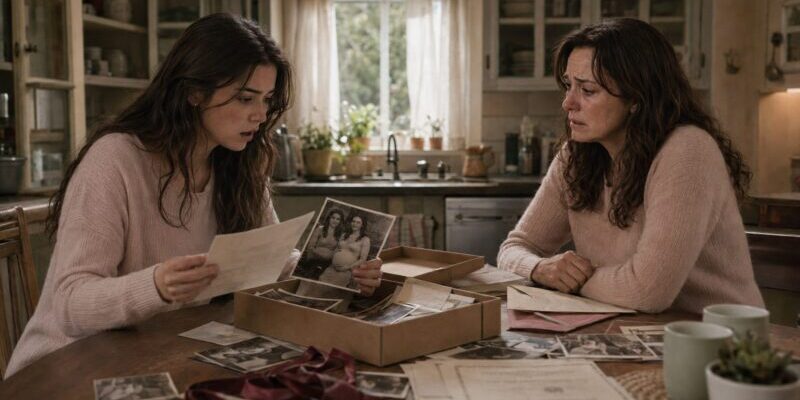
There were old photographs on top.
In one of them, my mother was very young, standing beside a girl who looked so much like her that at first, I thought the photograph showed two versions of the same person.
The other girl was pregnant, and my mother had one hand resting on her shoulder.
Beneath the photographs were letters, hospital records, an old copy of my birth certificate, and several pages stamped with the seal of a medical laboratory.
My father’s name was on the first page.
Mine was on the second.
After reading the next few lines, I sat there for several minutes, unable to understand what the words meant.
The results confirmed that the woman I had called Mom my entire life did not share a mother-daughter biological relationship with me.
She was biologically my aunt.
I read the same sentence again and again, hoping I had misunderstood it.
Then I found the results of another test.
They confirmed that the pregnant woman standing beside my mother in the photograph—her older sister, Anna—was my biological mother.
I raised my head and looked at the woman sitting across from me.
She was crying, but she didn’t try to defend herself. She only said that she would tell me everything, even if it meant I would never want to see her again.
Anna and my father had been together for years. By the time Anna became pregnant with me, their relationship had already become difficult.
My father was frequently away, while my mother—the woman who was actually my aunt—spent a lot of time in their home helping her pregnant sister.
During that time, she and my father began having an affair.
At first, they hid it.
Then Anna found out.
I had been born into a family that was already falling apart from the inside.
A few months after I was born, Anna left and temporarily placed me in her sister’s care. She said she needed to be alone for a few days so she could decide how to move forward with her life.
But while she was away, her car was involved in an accident.
She never came home.
According to my mother, from that day forward, she blamed herself not only for her sister’s death but also for everything that had happened before it.
She decided to raise me, at first as my aunt. But while I was still very young, I began calling her “Mom.”
She never corrected me.
Later, she moved to another city, changed certain details in the documents, and begged everyone in the family never to tell me the truth.
My father had been against it.
He argued that regardless of the mistakes they had made, I had the right to know who had given birth to me. But their relationship eventually collapsed completely, and he left.
He returned on my tenth birthday only because he didn’t believe my mother would ever tell me the truth willingly.
His letter was also inside the box.
He wrote that he didn’t expect me to forgive him because he, too, had participated in the lie in which I had been raised.
But he also wrote that he had left the box not to turn me against my mother, but to return my real story to me.
I couldn’t breathe.
Suddenly, every moment from my childhood seemed suspicious.
I remembered how relatives fell silent whenever I asked who I looked like. I remembered the way my mother avoided giving me details about my birth and how certain people looked at me with sadness whenever they saw me.
I felt as though I had spent my entire life living inside a story written by someone else.
I was furious.
I screamed and asked how she had been able to look into my eyes every day and remain silent. I asked how she could have denied me the chance to know the woman who gave birth to me, even if it could only have been through photographs and stories.
My mother never once tried to claim that what she had done was right.
She only said that at first, she had been afraid of losing me. Then, with every passing year, telling me the truth became more difficult.
Each year, she promised herself she would tell me on my next birthday. But whenever she saw me hug her and call her Mom, she lost the courage and remained silent.
I left the house that day and sat in my car crying for several hours.
But that evening, I returned.
When I walked inside, she was still sitting in the same place, as though she were certain I would never come back.
I looked at that woman and tried to see her as nothing more than my aunt.
I tried to erase from my mind all the years in which she had cared for me, loved me, and protected me.
I couldn’t.
I was still angry with her.
Even now, there are days when I don’t understand how I’m supposed to forgive a lie that lasted for so many years. But the feelings I had for her deep inside did not change.
She didn’t give birth to me.
She made terrible mistakes.
She took a part of my own history away from me.
But she was also the person who had given her entire life to raising me.
When she said through her tears that she would understand if I could no longer call her Mom, I sat down beside her and wrapped my arms around her.
I told her I still had many questions, that rebuilding my trust would take time, and that there were certain things I might never be able to forgive completely.
But I also told her what I knew with absolute certainty.
“You lied to me about where I came from, but the love you raised me with was never a lie. You’re still my mother.”
A year has passed since that day.
I now know my biological mother’s name. I have her photographs, and I know at least part of her story.
Sometimes, I wonder what she would have been like if she had survived, and whether I would have become the same person if she had raised me.
But when I say “Mom,” I still mean the same woman.
Not because I have forgotten the truth.
But because sometimes, a woman becomes a mother not only on the day a child is born, but on every day she chooses to remain by that child’s side.