Weeks after giving birth, my husband forced me to run every morning… until one day my mother-in-law showed up and exposed his real face 😱💔
I am writing this because if even one woman reads it and understands that this is not “strictness out of love,” but humiliation, then telling my story will not be for nothing.
I had given birth only six weeks earlier.
When I held my son, Noah, in my arms, I still couldn’t even sit properly. My delivery had been very difficult. Twenty-three hours of labor, then everything suddenly became chaotic. Doctors were running around, my husband, Carter, was standing beside me with a pale face, and in the end, they rushed me into an emergency C-section.
That day, I wanted only one thing.
For my baby to be alive.
And when I heard his cry for the first time, I thought, “That’s it. Everything was worth it.”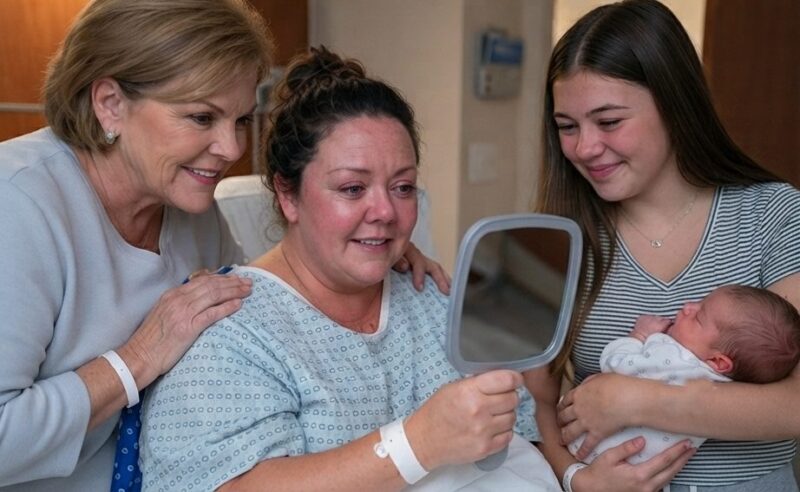
But I had no idea that after returning home, the pain in my body would become the smallest part of my suffering.
My doctor told me very clearly:
“No strenuous activity for at least eight weeks. No running, no workouts, no lifting. You had surgery.”
Carter nodded. He even asked what he could do to help me heal faster.
I looked at him in that moment and thought how lucky I was not to be alone in all of this.
But I was wrong.
During the first few days, he was nervous, but I thought it was normal. We had a newborn. We were all tired. At night, Noah cried a lot. I didn’t sleep. I fed him, changed him, and sometimes fell asleep sitting in a chair.
Meanwhile, Carter either slept in the other room or woke up in the morning with an irritated face and said:
“I’m tired too, you know.”
At the beginning of the sixth week, everything changed.
One evening, I was standing in front of the bathroom mirror. My shirt had lifted a little, and my stomach was visible — swollen, soft, still painful. I barely recognized myself. But it was my body. The body that had brought a child into the world.
Carter walked in and stood by the door.
He looked at me.
Not with love.
Not with compassion.
But as if I had ruined something.
“Have you looked at yourself lately?” he said.
I froze.
“What?”
He shrugged.
“I don’t want to sound rude, but you need to start getting yourself together. Our friends’ wives don’t stay like this after having babies.”
At first, I laughed. I thought it was some stupid joke.
But he wasn’t smiling.
“Carter, I’m still recovering.”
“Doctors always exaggerate,” he said. “If you move, you’ll get back to your normal shape faster.”
“Normal shape.”
Those two words settled inside me and stayed there.
The next morning at 5:30, he turned on the light.
I had barely slept all night. Noah had fallen asleep on my chest, and I was afraid to even move.
“Get up,” Carter said.
“What happened?”
“You’re going to run.”
I thought I was dreaming.
“I can’t.”
He pulled my sneakers out of the closet and threw them beside the bed.
“You can. You just don’t want to.”
I started crying.
Not loudly. I didn’t even have the strength to cry loudly.
“Please. It hurts.”
He looked at me as if I were the biggest problem in his life. Then, staring straight at my face, he said one sentence that still rings in my ears to this day. Continuation in the comments 👇‼️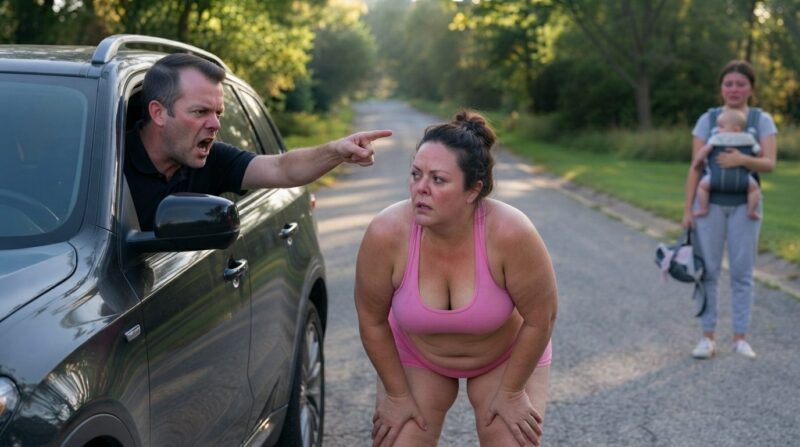
“You became a mother, not disabled.”
Our oldest daughter, Lily, is fifteen. She came out of her room, sleepy and frightened.
“Dad, what’s going on?”
“You’re going to watch the baby while your mother moves a little,” he said.
Lily looked at me. I saw her eyes fill with tears.
“Mom, you don’t look okay.”
I wanted to say, “No, I’m not okay. Help me. Call someone.”
But I was ashamed.
Yes, I am still ashamed to admit it, but in that moment, I was ashamed of my own pain.
I thought maybe I really was weak. Maybe other women were stronger. Maybe I complained too much.
I put on my sneakers and went outside.
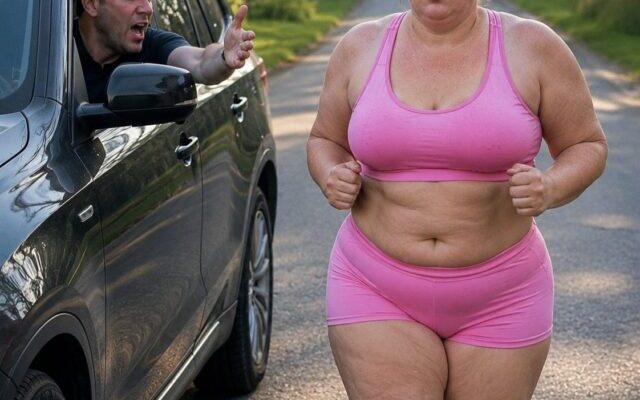
The morning was cold. There was no one on the street. It was just me, my shaking legs, my aching stomach, and Carter’s car behind me.
He didn’t run with me.
He followed in the car.
Slowly.
As if I were a dog that needed to be pushed forward.
After the first two minutes, I stopped. My heart was pounding, my incision was pulling, and I couldn’t breathe.
The car horn cut through the silence.
I flinched.
He rolled down the window.
“Don’t start making drama. Walk.”
So I walked.
And that was how it began.
Every morning.
Every day.
If I slowed down, he honked.
If I sat down on the curb, he told me I looked ridiculous.
If I begged to go back home, he took out his phone and photographed me from the side.
In the evenings, he showed me those pictures.
“Look. If you keep going, in a month you might at least look human again.”
I stopped arguing.
I simply stayed quiet.
I cried silently in the bathroom and turned on the water so Lily wouldn’t hear me. But she heard me. Children always hear what parents try to hide.
One day, she came up to me and whispered:
“Mom, I want to tell Grandma.”
Carter’s mother, Patricia, lived in another city. She was a strict woman, but fair. I had always respected her, but I didn’t dare call her. Carter always said:
“Don’t drag my mother into our problems.”
That day, I told Lily:
“No, don’t. Everything will pass.”
But nothing passed.
On Friday morning, I already felt like my body could no longer take it. There was a burning pain around my incision, my head was spinning, and Noah had not slept all night.
I told Carter:
“I can’t today. Please.”
He came close to the bed and said in a very calm voice:
“Do you know how hard it is to love a woman who has completely let herself go?”
At that moment, it felt like something inside me died.
I didn’t cry anymore.
I got up, got dressed, and went outside.
I walked down the street with my eyes barely open. Carter’s car followed me like always. A few houses later, I felt my legs weakening.
I slowed down.
The horn.
And right then, I saw a silver car parked at the corner of the street.
At first, I didn’t pay attention.
Until the door opened.
Carter’s mother stepped out of the car.
Patricia.
She didn’t say anything to me. She walked past me, but as she passed, she placed her hand on my shoulder for just a second. That tiny touch said more to me than a thousand words.
Then she walked straight to Carter’s car.
Carter rolled down the window with an annoyed face.
“What are you doing, standing in the road—”
Then he saw his mother.
He went silent instantly.
The color of his face changed.
“Mom…” he said so quietly I could barely hear him.
Patricia lifted her phone.
“Is this you?”
Carter looked at the screen.
Three seconds.
Then, on the fourth second, he opened the door, got out of the car, and dropped to his knees right there in the street.
Yes.
The man who had forced me to run after surgery dropped to his knees in front of his mother.
“Mom, please, don’t do this,” he began. “Please, I can explain everything.”
Patricia’s voice was cold.
“What exactly are you going to explain? That six weeks after your wife’s C-section, you follow her in a car and honk at her so she’ll run?”
I put my hand over my mouth.
Carter turned toward me.
There was fear in his eyes.
Not fear for my pain.
Fear for his secret.
“Did you film all of this?” he said to me.
Patricia answered for me.
“No. Your daughter did.”
That was when I understood what had happened.
Lily.
My little girl, who had silently watched every day as her father broke her mother, had finally done what I hadn’t had the courage to do.
Patricia said:
“She sent me everything. Your honking. Your words. Your photos. The recording where you say it’s hard to love your wife because she changed after having a baby.”
Carter turned pale.
“She’s a child. She doesn’t understand.”
Patricia took one step forward.
“She understands very well. And the painful part is that a fifteen-year-old girl has more manhood than you do.”
Carter started begging.
“Mom, please, don’t send it to anyone. I’ll change. I made a mistake. Don’t involve my job, please.”
Patricia laughed.
But it was not a happy laugh.
“Your job? That’s what you’re thinking about right now?”
Then she said something I will never forget.
“I raised you to protect your family, not to make your family afraid of you.”
She turned toward me.
For the first time that morning, someone asked me:
“Does it hurt?”
That simple question broke me.
I nodded and started crying.
Patricia came closer, took off her coat, wrapped it around my shoulders, and said:
“That’s enough. Not one more step.”
She put me in her car and took me to the hospital.
On the way there, I didn’t say anything. I only stared out the window and thought, “How did I get here? How did I start believing I deserved this?”
At the hospital, the doctor said I could have had a serious complication if I had continued like that.
Lily came in holding Noah. When she saw me, she started crying.
“Mom, I’m sorry. I was afraid you would be angry.”
I hugged her and said:
“You saved my life.”
That day, Patricia called a lawyer. Then she called Carter’s boss, who, as it turned out, was an old friend of hers. I won’t write the details, but I will only say this: that day, Carter lost much more than my trust.
Yesterday, he sent me a message.
“Please tell my mother you forgave me. I can’t lose everything.”
I stared at that message for a long time.
Then I looked at my son, sleeping peacefully beside me.
I looked at Lily, who could finally speak in the house without fear.
And I understood something.
He was not afraid of losing me.
He was afraid of losing the life where he could hurt me and get away with it.
I replied with only one sentence:
“You lost everything the morning you forced me to run while I could barely walk from the pain.”
Then I blocked him.
I am not writing this so you will feel sorry for me.
I am writing it because too many women spend years hearing, “I just want you to look good,” “I’m saying it for your own good,” “Don’t exaggerate,” “All women go through this.”
No.
Love does not humiliate you.
Love does not force you to run in the street while your body is still healing.
Love does not measure your pain by the size of your stomach.
Sometimes rescue comes from the person you least expect.
In my case, it was my husband’s mother.
And the biggest hero was my fifteen-year-old daughter, who did what I did not have the strength to do.