I rejected a millionaire and chose my broke best friend instead… but on our wedding day, while we were sitting at a table eating burgers, my husband pulled an old envelope out of his pocket and whispered, “Dear, you don’t know the most important thing about me.” 💔💔
Vincent Hale, my father’s boss, had offered me everything.
A five-carat ring.
A garage with three cars whose names I couldn’t even pronounce correctly.
A penthouse with windows so tall it looked as if the whole city belonged to him.
My mother cried when I rejected him.
My father didn’t cry. He just stared at me as if I had thrown our family name into the trash.
“You will regret this,” he said.
My older sister, Brooke, sent me only one message.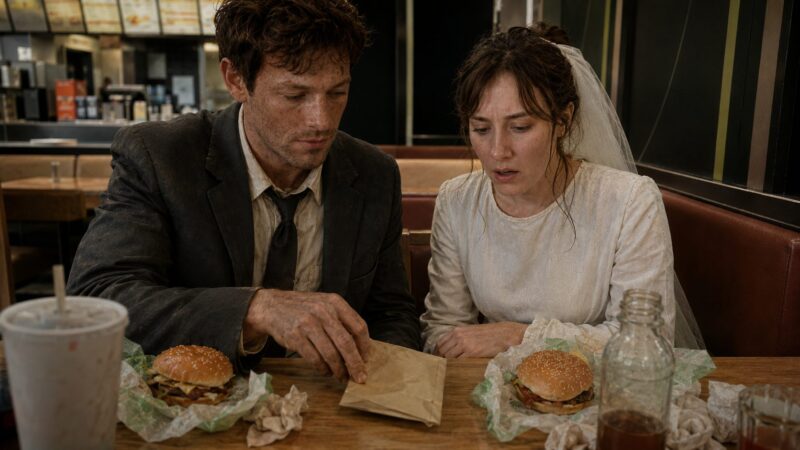
“You’re an idiot. He will never be able to give you anything.”
By “he,” she meant Mason Reed.
My best friend since high school.
The boy who used to sit with me behind the gym when I felt invisible. The boy who worked at an auto shop, drove a fifteen-year-old pickup truck, and always smelled like motor oil no matter how much he washed. The boy who remembered exactly how I drank my coffee. The boy who brought me soup when I was sick. The boy who never once made me feel small because I counted discount coupons at the grocery store.
Beside Vincent, I felt like an expensive jewel in a display case.
Beside Mason, I felt like a human being.
That was why I chose Mason.
And my family erased me from their lives.
No calls.
No birthday wishes.
No invitation to Sunday dinner.
My mother even mailed back the small framed photo I had given her — a picture of me and Mason by the lake.
No note.
Just the photo, wrapped in old newspaper, like garbage.
But even then, I didn’t regret it.
Our wedding day was nothing like the weddings I had imagined when I was a little girl.
There was no grand hall.
No flowers.
No white chairs lined up under trees.
I wore a simple white dress I had found at a thrift store for only twelve dollars. Mason wore his late father’s old suit jacket. The sleeves were a little too long, and one of the buttons didn’t match the others.
After getting married at city hall, we walked to a small bistro downtown because it was the only nearby place that didn’t require a reservation.
We ordered burgers and shared a bottle of wine we had saved money for over three weeks.
When the waiter heard that we had just gotten married, he smiled and said,
“Congratulations.”
The couple sitting at the table next to us turned around.
The woman’s eyes moved over my cheap dress, then over Mason’s worn sleeves, then down to the burgers on our plates. She leaned toward her husband and whispered something. Then both of them looked at us with a small, pitying smile.
I saw it.
Mason saw it too.
But under the table, he squeezed my hand.
And I remember clearly thinking at that moment:
I made the right choice.
That was when Mason went silent.
It wasn’t the kind of silence he had when he was tired.
It wasn’t the kind of silence he had when he was thinking about something.
This was different.
His face changed.
The warmth left his eyes, and something heavy appeared there.
“Mason?” I whispered.
He slowly reached into the inside pocket of his father’s old jacket.
His hand was trembling.
“Dear,” he said in a low voice, “you don’t know one thing about me.”
My heart tightened.
For one terrifying second, I thought he was about to tell me he was sick. Or in debt. Or that he had made some mistake he had been hiding from me.
But instead, he pulled a folded yellowish envelope out of his pocket.
It was old.
The edges were soft, almost torn.
On the front, written in faded black ink, was my full name.
Ava Caroline Monroe.
My breath stopped.
“Mason,” I said slowly, “why is my name on that?”
He looked at me as if the answer could break me.
“I couldn’t show you this until we were married,” he said. “Your parents didn’t cut you off because I’m poor. They were afraid of me… because I know their secret. Continuation in the comments 👇‼️”
He placed the envelope on the table between us.
“Look.”
With frozen fingers, I opened the envelope.
There was a photograph inside.
At first, I didn’t understand what I was looking at.
In the photo, I was a little girl, maybe four years old, sitting on the lap of an elderly woman. She had silver hair and kind eyes. I recognized her immediately, even though my parents had almost never spoken about her.
My grandmother.
Eleanor Whitmore.
I had always been told that she was a bitter woman. Cruel. That she had never loved anyone. That she had died with debts and an empty house.
But in the photo, she was holding me as if I were the most precious thing in the world.
On the back of the photograph, written in blue pen, were the words:
“For my Ava. Everything I built was always meant for you.”
My hands began to shake.
There were more papers inside the envelope.
A copy of a will.
Bank documents.
Trust fund records.
A letter.
I opened the letter last.
My grandmother’s handwriting covered the whole page.
“My sweet Ava,
If this letter has reached you, then someone tried to hide the truth from you.
I did not leave my estate to your parents.
I did not leave my company shares to your father.
I left everything to you.
Your parents were only supposed to manage the trust until your twenty-fifth birthday or until your marriage — whichever happened first.
Choose love, my darling. But never allow anyone to sell your life for comfort.”
By the time I reached the last line, my eyes were burning.
I looked at Mason.
“I don’t understand,” I whispered. “I turned twenty-five last year.”
“I know,” he said.
The room seemed to tilt in front of my eyes.
“My parents told me there was no money. They told me Grandma died in debt.”
Mason’s jaw tightened.
“They lied.”
I looked at the documents again.
At first, the numbers made no sense.
Then they did.
Houses.
Shares.
Accounts.
A trust fund with so much money that I had never even imagined it.
And beside several withdrawals was my father’s signature.
Again and again.
My mother’s signature was there too.
Then, on another page, Vincent Hale’s name appeared.
My heart dropped.
“What does Vincent have to do with this?”
Mason leaned closer to me.
“Your father used the money from your trust fund to keep his position at Vincent’s company. Vincent knew the money wasn’t his. He helped hide it. That’s why he wanted to marry you.”
I felt sick.
“No.”
“Yes,” Mason said gently. “If you had married him, he was planning to make you sign over full control to him. Your parents were going to convince you that it was normal. A marriage agreement. Protection. Family business.”
My burger sat untouched.
The cheap wine.
The small table.
The couple looking at us with pity.
Everything blurred.
“My whole life,” I whispered, “they made me feel like I had nothing.”
Mason’s eyes filled with pain.
“That was exactly their goal.”
I pressed my hand to my mouth.
Suddenly, every cruel word made sense.
My mother telling me I should be grateful.
My father telling me I was too emotional to make decisions.
Brooke laughing when I used discount coupons.
Vincent smiling as if he were saving me from a poor life.
They hadn’t wanted to save me.
They had wanted to own me.
“Where did you get this?” I asked.
Mason looked down at his father’s jacket.
“My father worked as an accountant for your grandmother until she died. When he found out what your parents were doing, he kept copies of everything. He tried to warn someone, but they fired him. One month later, he died.”
His voice broke for the first time.
“Before he died, he told me there was a letter hidden inside this jacket. He said that if I ever loved you, I had to wait until you made your choice freely. Not for money. Not for revenge. Not because I told you some secret.”
I stared at him.
“So… this whole time, you knew?”
“Not everything,” he said. “I knew there was a secret. I only opened the envelope the night you told me your parents had cut you out of their lives. That was when I understood why they hated me.”
“Why didn’t you tell me then?”
“Because I didn’t want you to marry me because of this,” he said. “And I didn’t want you to think I loved you because of it.”
Tears slid down my face.
“Mason…”
He reached across the table and took my hand.
“I married you when everything we had was a city hall receipt, two burgers, and a forty-dollar bottle of wine. That part was real. This changes nothing.”
Before I could answer, the door of the bistro opened.
Cold wind rushed inside.
I turned around.
My father walked in.
My mother was behind him.
And between them stood Vincent Hale in a dark suit, looking at me as if I belonged to him.
My blood turned cold.
“How did they know we were here?” I whispered.
Mason didn’t look surprised.
“They followed us.”
My father stopped beside our table.
His eyes went straight to the yellow envelope.
For the first time in my life, I saw fear on his face.
“Ava,” he said, forcing a smile, “come outside. We need to talk privately.”
I didn’t move.
My mother’s voice trembled.
“Sweetheart, this isn’t what you think.”
Vincent’s face was calm, but his eyes were sharp.
“Mason,” he said, “you’re making a mistake.”
Mason slowly stood up.
“No,” he said. “You made the mistake. You thought she would choose money over love.”
My father reached for the envelope.
I grabbed it first.
He froze.
Then I stood up too.
For years, I had lowered my voice around my father.
That day, in a twelve-dollar wedding dress, beside my broke husband, in the middle of a tiny bistro, I finally found my voice.
“No,” I said.
My mother blinked.
“Ava…”
“No,” I repeated. “You don’t get to explain this away. You don’t get to call me ungrateful. You don’t get to tell me I’m confused.”
Vincent took one step toward me.
Mason immediately stood in front of me.
The entire restaurant went silent.
The waiter was standing near the counter, holding a tray he had forgotten to put down.
My father looked around and lowered his voice.
“You have no idea what you’re doing.”
I looked straight into his eyes.
“You’re right,” I said. “For most of my life, I had no idea.”
Then I lifted the envelope.
“But now I do.”
Mason took out his phone.
“My lawyer already has copies,” he said. “So does the trust office. If anything happens to these papers, it won’t change anything.”
Vincent’s mask cracked.
My mother began to cry, but this time her tears did not move me.
Because I finally understood.
Some people cry because they regret what they did.
And some people cry because they got caught.
My father whispered,
“We are your family.”
I looked at Mason’s worn jacket.
At his trembling hand, still holding mine.
At the cheap wedding ring on my finger.
Then I looked again at the people who had tried to sell my future.
“No,” I said calmly. “He is my family.”
Three months later, the truth became public.
My father lost his position.
Vincent disappeared from the city before the investigation was even over.
My mother tried to call me every day for two weeks, then stopped when she realized I would not answer.
Brooke sent one final message.
“You think you won because you got money?”
I deleted it.
Because she still didn’t understand.
The money was not the victory.
The victory was sitting beside Mason on the porch of the small house we had decided to keep.
Not the penthouse.
Not the mansion.
A small house with old floors, a crooked mailbox, and a garage in the back where Mason still repaired cars because he loved the work.
One evening, he found me standing in the kitchen, looking at my grandmother’s photo.
He came up behind me and wrapped his arms around my waist.
“Do you regret it?” he asked softly.
I turned toward him.
“The burgers?”
He laughed.
I smiled through tears.
“No,” I said. “I think that was the richest wedding I could have had.”
Because that day, I understood something I will never forget.
A man can offer you diamonds and still see you as property.
And another man can have nothing in his pocket…
except the truth that sets you free.