The Dinner I Thought We’d Remember for the Right Reason
There are moments in motherhood that fill you with pride.
A good report card. A thoughtful gesture. A glimpse of the person your child is becoming that makes you think, Maybe I’m doing something right.
And then there are moments that make you question everything.
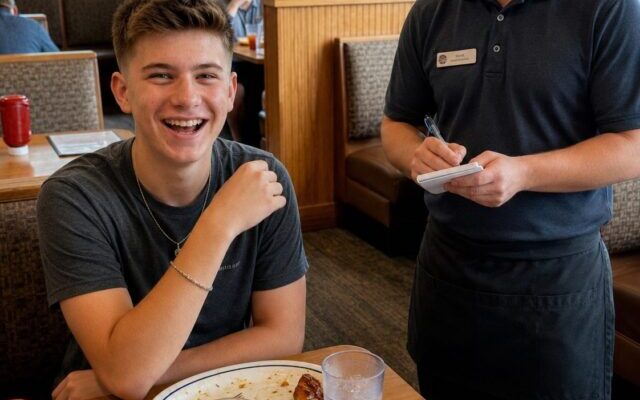
The night my fourteen-year-old son, Leo, laughed at a waiter with Down syndrome was one of those moments.
I didn’t scream. I didn’t ground him or lecture him in front of everyone.
Instead, I took him home and opened a wooden box I had kept hidden for almost twenty years.
Inside was the story of the cruelest thing I had ever done—and the friend I never got the chance to apologize to.
That evening had started happily.
Leo had brought home the best report card of his life: straight A’s. His teachers praised his responsibility, and his basketball coach called him a natural leader.
To celebrate, I took him to an expensive steakhouse he had wanted to visit for months. I had worked extra shifts at the hospital to afford it.
When he realized where we were going, his face lit up.
“Mom, seriously?”
“Seriously.”
He hugged me. “You’re the best.”
For one perfect moment, all those extra hours felt worth it.
We were seated near the center of the restaurant when our waiter approached.
His name was Sam. He was in his early twenties and had Down syndrome.
“Good evening,” he said carefully. “My name is Sam. I’ll be taking care of you tonight. I’m still learning.”
“It’s nice to meet you, Sam,” I said.
He smiled and turned to Leo.
“What would you like to drink?”
Leo stared at him, then at me.
A tiny smirk crossed his face.
“Lemonade,” he said.
Sam wrote it down and walked away.
Leo laughed under his breath.
I looked at him. “Leo. Don’t.”
“I didn’t do anything.”
I held his gaze, hoping the warning was enough.
It wasn’t.
When Sam returned with our drinks, he began explaining the evening special. He stumbled over the word “sirloin.”
“Sorry,” he said. “I get stuck on that word sometimes.”
“You got it,” I told him. “You’re doing fine.”
Then I heard Leo snort.
His shoulders were shaking.
I nudged his foot beneath the table.
He rolled his eyes.
Later, while Sam was gone, Leo showed me messages he had sent to his friend Tyler, making fun of the waiter.
“Delete those,” I said.
“Why?”
“Because they’re cruel.”
“He’ll never see them.”
“That doesn’t make them okay.”
Leo shrugged.
Then, when Sam returned with bread, Leo waited until his back was turned.
He stiffened his shoulders, copied Sam’s careful walk, and whispered in an exaggerated voice:
“I hope… you enjoy.”
Then he laughed.
No one else did.
An older couple nearby stared at him. A family across the aisle went silent.
Pour découvrir la suite, consultez les commentaires 👇👇👇

And suddenly, I felt something deeper than anger.
Shame.
My son wasn’t simply making a careless joke. He was enjoying making someone else feel smaller.
I stopped Sam before he walked away.
“Sam, I’m sorry.”
He looked confused.
“For what?”
I glanced at Leo.
“For the way my son behaved.”
Sam looked down.
“Oh.”
“I’m sorry,” I repeated. “You deserved better than that.”
“It’s okay,” he said quietly.
“No,” I replied. “It really isn’t.”
I paid the bill, left a large tip, and took Leo home.
In the car, he complained.
“It was just a joke. You’re making this way bigger than it was.”
I said nothing.
When we got home, I told him to sit in the kitchen.
Then I went to my bedroom and pulled an old wooden box from the back of my closet.
I hadn’t opened it in years.
Inside were photographs, letters, a friendship bracelet, a basketball ticket, and an old birthday card.
Leo picked up a photograph.
It showed me as a teenager standing beside a smiling boy in a blue shirt.
The boy had Down syndrome.
“Who’s this?”
“Daniel.”
“Was he related to us?”
“No.”
I looked at the photograph.
“He was my best friend.”
Before college, before his father, before almost everyone else in my life, there was Daniel.
I was sixteen when he transferred to my school. My father had just died, and I was struggling badly with grief.
Most of my friends eventually stopped knowing what to say.
Daniel didn’t.
Every lunch period, he sat beside me.
He shared his food, told terrible jokes, and made sure I never had to be sad alone.
He remembered my favorite candy after hearing me mention it once.
He loved basketball and dogs. He remembered people’s birthdays and always asked how they were doing.
Daniel helped me through the worst year of my life.
But other students noticed our friendship.
They mocked him. They imitated his speech and laughed at the way he walked.
Usually, Daniel smiled through it.
Then one Friday afternoon, everything changed.
I was standing with a group of popular girls when Daniel saw me and smiled.
He walked toward us.
One of the girls joked that he was my boyfriend.
Another mocked the way he talked.
I knew it was wrong.
I could have defended him.
Instead, I laughed.
It lasted only a few seconds.
But Daniel heard me.
I watched his smile disappear.
He didn’t yell. He didn’t argue.
He simply turned around and walked away.
I told myself I would apologize on Monday.
But Daniel wasn’t there Monday.
Or Tuesday.
His family had moved to another state that weekend.
I never got the chance to apologize.
A letter he sent afterward was still in the box.
He thanked me for being his friend. He told me I had made school better for him and wished me plenty of reasons to smile.
Leo read it twice.
“He still called you his friend?”
“Yes.”
“Even after what you did?”
“Yes.”
I looked at my son.
“You know what I told myself after that day?”
He shook his head.
“That it was just a joke.”
Leo went silent.
“Exactly what you said tonight.”
His eyes filled with tears.
“I didn’t think about how Sam would feel.”
“I know.”
“I just wanted Tyler to laugh.”
I reached for his hand.
“I wanted those girls to laugh too.”
He started crying.
“I’m sorry.”
“I know.”
“Not just to you,” he said. “I’m sorry to Sam.”
He remembered Sam’s face when I apologized.
“I made him stand there and pretend it was okay.”
I squeezed his hand.
“The people we find easiest to laugh at are sometimes the people working hardest to make everyone around them comfortable.”
After a long silence, Leo asked, “Can we go back tomorrow?”
The next afternoon, he was waiting by the door before I even picked up my keys.
At the restaurant, he was nervous.
“What if he doesn’t forgive me?” he asked.
“Then you respect that.”
We found Sam near the entrance.
“Welcome back,” Sam said.
Leo stepped forward.
“I’m not here to eat. I came because I need to tell you something.”
Sam waited.
“What I did yesterday was cruel. You were doing your job and being kind to us, and I made fun of you anyway.”
His voice shook.
“I wanted somebody else to laugh. I didn’t think about what it would feel like for you. That’s not an excuse. You didn’t deserve it, and I’m ashamed.”
Sam was quiet for a moment.
Then he smiled.
“It’s okay.”
Leo shook his head.
“No. It wasn’t okay. But I hope someday you can forgive me.”
Sam extended his hand.
Leo shook it.
“Thank you for coming back,” Sam said.
“Could we start over?”
“Yeah,” Sam replied. “I’d like that.”
Leo smiled.
A real smile. Not the mocking grin from the night before.
Something warmer.
Something humbler.
I thought that would be the end of it.
It wasn’t.
A few weeks later, Leo told me about a Saturday recreation program for teenagers and young adults with developmental disabilities.
“They need volunteers for basketball,” he said.
“Do you want to help?”
“Yeah.”
“Why?”
He thought for a moment.
“Because I think I’ve spent too much time assuming I know people before I actually know them.”
That Saturday, I dropped him off.
When I picked him up, he looked exhausted.
“How was it?”
“They destroyed me at basketball.”
I laughed.
Then he smiled.
“But every time I missed, they cheered for me. It was actually pretty great.”
I looked at him and saw not just the boy he had been, but the man he might become.
That night at the restaurant didn’t magically make Leo perfect.
He still makes mistakes. He still says things without thinking.
But something changed.
He began noticing people differently.
He stopped treating differences as invitations to joke. He started asking questions instead of making assumptions.
Most importantly, he learned that kindness isn’t proven by how you treat people when everyone is watching.
It is revealed by what you say when you think the person will never hear you.
The wooden box is still in my closet.
Daniel’s photographs and letters are still inside, along with the bracelet he spent two weeks making for me.
For years, that box felt like punishment.
Now it means something different.
I still regret what happened. I never found Daniel. I never got to tell him how sorry I was or how much his kindness meant to me.
But I finally understood something.
Our worst mistakes cannot always be undone.
That doesn’t mean they have to be wasted.
Sometimes regret becomes a warning we pass to our children.
Sometimes an old wound becomes a lesson.
And sometimes the people society underestimates are the ones who teach us the greatest truths about dignity, forgiveness, and kindness.
That night, I thought I was teaching my son how to treat people.
But somewhere between Sam’s quiet grace and Daniel’s twenty-year-old letter, I realized something else.
Daniel was still teaching me too.
And this time, I made sure I listened.