The night I was fired from my job, my sister didn’t ask if I was okay… She only screamed, “Who’s going to pay my car loan now?” And just a few hours later, my entire family learned a secret that literally made their house collapse 😱💔
I thought for a long time about whether I should write all of this or stay silent.
Because when your story is about your own family, you always feel guilty. Even when they are the ones who broke you. Even when you lived for them for years, and they only remembered you at the end of the month, when the loans had to be paid, the debts, the utilities, the medicine, the car, the renovations, even your sister’s next meaningless luxury.
I won’t hide my name.
I am Amelia Reed.
For twelve years, I was not a daughter to my family. I was not a sister. I was not a person.
I was simply a paycheck.
A breathing bank account.
The one they could call at midnight and say, “We need money tomorrow.” The one they could blame if someone’s life didn’t turn out comfortably. The one they always told, “You’re strong, you’ll understand.”
And do you know what it really means when your family tells you, “You’re strong”?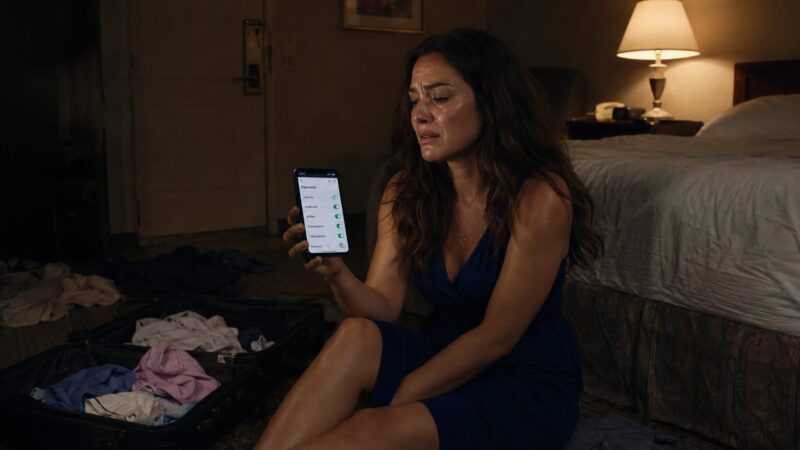
It means your pain doesn’t count.
Your exhaustion doesn’t count.
Your dreams don’t count.
You have to stay standing so everyone else can sit comfortably.
That night, I walked into the house holding a white envelope tightly in my hand. Inside that envelope were my termination papers. The company had made cuts, and my name had also ended up on the list.
I won’t say I wasn’t scared.
I was scared.
Because for twelve years, I had worked without stopping. While my friends were getting married, traveling, having children, I was sitting in an office calculating whether I should pay for my mother’s medicine that month or cover my sister’s next car payment.
I walked into the house and, for the first time, thought maybe they would hug me.
Maybe my mother would say, “My daughter, it’s okay, we’re here for you.”
Maybe my father, who had spent years being proud of how hardworking I was, would finally see that I was human too.
But the moment I stepped into the living room, I realized they already knew.
My mother, Diana, was sitting on the couch. My father, Harold, was standing by the window. My sister, Sophie, had her feet up on the table and was typing something on her phone.
There was tea on the table.
Cookies.
And a coldness that slipped under my skin before anyone even spoke.
Sophie was the first to lift her head.
She didn’t say, “Amelia, are you okay?”
She didn’t say, “What happened?”
She only looked at me with irritation and said,
“Is it true? Did they fire you?”
I took a breath.
“They laid me off. It’s not the same thing.”
She rolled her eyes, as if my words annoyed her.
“I don’t care about the difference. I care about who’s going to pay my car loan now. The payment is due Friday.”
I remained standing by the door.
In that moment, something inside me slowly cracked.
Not completely.
Not yet.
A person doesn’t break all at once. At first, they simply go silent.
My mother set her cup down on the saucer. The sound was small, but I still remember it. It sounded like the strike of a judge’s gavel.
“Amelia, sit down. We need to talk about the budget.”
The budget.
That was what my mother called my life.
I sat down.
I don’t know why I sat. Maybe because I had been taught since childhood that you don’t talk back when your mother speaks. Maybe because I still hoped the next words would be at least a little human.
But she continued.
“Sophie is going through a difficult time right now. Her car situation is important. Besides, she has decided to start her small business, and she needs a peaceful space. Since you are now… not working, I think it would be right for her to move into your room.”
I looked at her and didn’t understand.
“My room?”
My father cleared his throat.
“I already moved some of your things down to the garage.”
For a moment, the world went silent.
As if someone had turned off the sound.
I stood up and went upstairs.
I opened the door.
My room was no longer mine.
My shelves were empty. My books were packed into boxes. My clothes had been thrown carelessly onto the bed. And my college graduation photo had been taken off the wall. The only photo where I looked at myself with pride.
All that was left there was the tiny hole from the nail.
It’s a strange thing—sometimes people remove you from your own life not by screaming, but simply by taking your photo off the wall.
My father came into the room holding a new box.
He began folding my shirts so calmly, as if he were clearing out some storage room.
“Dad,” I said, “look at me.”
He didn’t look at me. Instead, he said one sentence I will never forget. Continuation in comments 👇‼️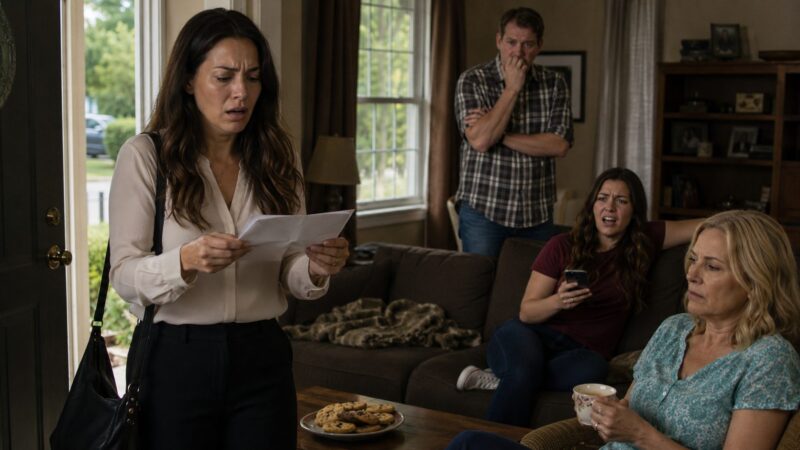
“Sophie needs this house more than you do.”
Not because it was the cruelest thing.
But because my father said it calmly.
Without shame.
Without thinking that I was the one who had kept the mortgage on this house paid for twelve years. I was the one who had paid off his debts when he nearly lost everything. I was the one who paid for my mother’s surgery. I was the one who bought Sophie a car, then paid the loan, then paid the insurance, then loaded her fuel card, and she had never thanked me even once.
“Where am I supposed to go?” I asked.
My father finally looked at me.
And do you know what he said?
“You always find a way. You always end up fine.”
That was the moment I understood they didn’t love me.
They had simply gotten used to my usefulness.
I picked up the box.
I put a few clothes inside, my documents, the little ring my grandmother had left me, and my bag.
When I went downstairs, my mother blocked my way.
“Amelia, don’t act like we’re throwing you out. In a family, sacrifices have to be made.”
I looked into her eyes.
“I’ve been making sacrifices for twelve years. You only remembered that word now, when I had nothing left to give.”
Sophie laughed from the couch.
“Don’t be dramatic. And don’t forget the car payment. My credit history should not be ruined because of you.”
I said nothing.
I left.
That night, I sat on the floor of a small hotel room. I hadn’t turned on the light. My phone was lying beside me.
I was waiting.
I don’t know for what.
Maybe for my mother’s call.
Maybe for a message from my father.
Maybe for even one short, “Did you arrive safely?”
But nobody wrote.
At 11:48 p.m., only one message came.
From Sophie.
“Send the loan money by Friday. I don’t want to be late.”
I stared at the screen for a long time.
Then, for the first time, I didn’t answer.
Instead, I opened my banking app.
And I began turning things off.
First, Sophie’s automatic car payment.
Then my mother’s shopping card.
Then my father’s insurance payments.
Then the house utilities.
Then the biggest transfer.
The monthly house payment.
At that moment, I laughed out loud for the first time.
Not from cruelty.
From freedom.
Because there was one thing they didn’t know.
The house they had thrown me out of was not theirs.
Years earlier, my father had nearly lost the house because of his debts. He practically begged me to help him. I helped. But when the documents were being reorganized, the lawyer warned me:
“If you want to protect yourself, register the house under your company’s name.”
So that was exactly what I did.
My family thought I was simply paying for their house every month.
But in reality, the house belonged to my company.
And the company belonged to me.
The same company they knew nothing about.
The company I had created three years earlier at night, when they thought I was simply coming home late from work.
And that wasn’t even the most shocking part.
My job hadn’t “destroyed” me.
I had already been preparing for months to leave that place, because my new office was opening in Austin.
A sign was already hanging on the door.
A. Reed, Co-Founder
They thought they had finished me.
But that night, they simply lost me.
The next morning at 8:12, Sophie called.
I didn’t answer.
At 8:14, she called again.
Then she wrote:
“What did you do? The payment didn’t go through.”
I replied with only one sentence.
“I’m no longer paying for a car that isn’t mine.”
Five minutes later, my mother called.
“Amelia, have you lost your mind? Sophie is crying.”
“And I was crying on a hotel floor last night, Mom. Nobody noticed.”
“Don’t compare. You’re older. You should understand.”
“I understand. Too late, but I understand.”
On the third day, I heard my father’s voice.
He was no longer the same man who had packed my clothes in my room. His voice was trembling.
“Amelia… the bank called. They said the house payments have stopped. Then they said some company name. What does this mean?”
I was standing near the glass window of my new office. The sun was shining outside. The city was moving. And for the first time, I wasn’t rushing to save anyone.
“It means, Dad, that the house you threw me out of is not yours.”
Silence.
Long silence.
Then he barely whispered,
“What are you saying?”
“The house is under my company’s name. And the company is mine.”
For a few seconds, he couldn’t find words.
“Amelia… we’re family.”
I closed my eyes.
That word.
Family.
They always kept that word like their final weapon. They used it only when they needed my conscience.
“Family doesn’t empty a daughter’s room on the night she loses her job.”
He went silent.
“I’m giving you thirty days to find a new place,” I said. “After that, the house will be closed for renovations.”
“You’re leaving us on the street?”
I took a slow breath.
“No, Dad. I’m simply giving back the reality you gave me.”
A week later, Sophie’s car was taken right in front of her salon. She posted on social media that her “sister had betrayed her.”
My mother told relatives that I had become cold, heartless, and arrogant.
My father came to my office.
He stood in the reception area wearing an old coat, his face tired, holding an envelope in his hand. He probably wanted to talk. He probably understood for the first time that I was not the daughter he could use and then pack into a box.
My secretary walked into my office and said,
“Your father is here.”
I looked at the sign on the glass door.
Amelia Reed — Co-Founder
And do you know what I did?
I didn’t go out to meet him.
I didn’t run.
I didn’t save him.
I only said,
“Please tell him that Ms. Reed has no meetings today.”
A few minutes later, I saw him leave the building.
Smaller.
Silent.
Looking the same way I had looked that night, when I was thrown out of my own room.
But I wasn’t taking revenge.
I had simply, finally, stopped sacrificing myself for people who hadn’t even included my pain in their list of expenses.
That evening, I went to my beach house.
Yes, there was also that house.
A small white house with blue windows, only a few steps from the ocean. A house nobody knew about, because I had always learned to hide my happiness so my family wouldn’t say, “If you have it, then give some to us too.”
I sat on the porch with a cup of warm tea in my hand, and for the first time in many years, I turned off my phone.
No one could call me.
No one could say, “You have to.”
No one could turn my love into an invoice.
And that night, I understood one thing.
Sometimes your life doesn’t collapse on the day you lose your job.
Sometimes that is the very day your life begins.
And the most painful truth is this: when you stop being useful to certain people, they don’t feel like they’ve lost you.
They simply get angry because they can no longer use you.