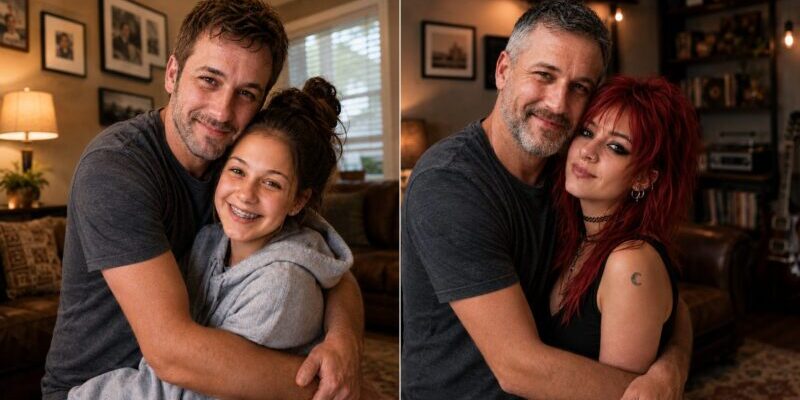
I raised my daughter alone after her mother died… but on her college graduation day, she stood on stage and revealed the secret pain she had carried in her heart for years 😱💔
I’m writing this story on my Facebook page because today became the longest day of my life.
And the most beautiful one.
My name is David Miller. I live in a small town in America, where people still remember what someone’s child wore to school, whose daughter dyed her hair, and whose son was seen with the wrong friends.
In a town like that, it is hard just to live.
And raising a child is even harder.
Especially when you are a man.
Especially when your daughter is growing up without a mother.
Especially when the whole world thinks you will not be able to do it.
My wife, Emma, died in a car accident when our daughter, Haley, was only five years old.
That night, I sat in the hospital hallway with the smell of Emma’s perfume still on my hands. The doctor was saying something, but I could not hear the words. I only remember that at some point, little Haley pulled on the sleeve of my coat and asked:
“Daddy… does that mean Mommy won’t hug us anymore?”
At that moment, I understood that if I broke, my daughter would fall with me.
I hugged her and said:
“I will love you enough for both of us.”
But honestly… I had no idea how.
I was an ordinary man. I worked at an auto repair shop, my hands were always greasy, I liked silence at home, and I had no idea how to braid a little girl’s hair.
The first weeks were painful.
Every morning, I stood in front of the mirror and tried to fix Haley’s hair. One side would stay too high, the other side would fall into her eyes. She would silently look at me through the mirror and finally whisper:
“Mommy did it prettier.”
I would smile, but inside, I was breaking.
I bought pink dresses.
I bought dolls.
I bought shiny shoes.
I bought everything people said “a little girl should love.”
But Haley looked at all of it as if she were looking at someone else’s life.
Instead of dolls, she collected small model cars.
Instead of dresses, she wore oversized shirts.
She left the shiny shoes in the closet and went outside in worn black sneakers.
At first, I was afraid.
Not of what she was becoming.
But of what people would say.
One day, my mother told me:
“David, you are raising a girl, not a boy.”
I had no answer.
That same evening, Haley was sitting on the floor, her hair cut short, bruises on her knees from falling out of a tree, drawing something. I walked over. She quickly turned the paper over.
“What are you drawing, sweetheart?”
She shrugged.
“Nothing.”
I did not take the paper. I did not force her to show me. I only sat beside her.
A few minutes later, she said on her own:
“At school, they told me I’m weird.”
I felt my throat tighten.
“And what do you think?”
She stayed silent for a long time.
Then she said:
“I don’t know how I’m supposed to be a girl.”
I will never forget those words.
I could have said, “Don’t talk like that,” “Be normal,” or “People are right.”
But I simply looked at her and said:
“Haley, you don’t have to learn how to be a girl the way other people expect. You only have to learn how to be a person in your own way.”
She did not answer.
But that night, for the first time in months, she came into my room, lay down beside me, and fell asleep with her hand resting on my arm.
The years passed.
My daughter did not grow up the way people expected.
At fourteen, she dyed the ends of her hair dark blue.
At fifteen, she started wearing black.
At sixteen, she got a second earring.
At seventeen, she painted her bedroom door dark gray and wrote on it in small letters:
“Don’t fix me.”
I stood in front of that door for a long time, staring at those words.
The neighbors talked.
“David has lost control of his daughter.”
“If her mother were alive, she would never be like that.”
“That child has changed too much.”
“Black clothes, strange hair… this won’t end well.”
I heard all of it.
But I saw what they did not see.
I saw Haley studying late at night until her eyes were red.
I saw her secretly buying food with the little money she earned and leaving it at the door of the homeless elderly woman on our street.
I saw that when I came home tired from work, there would be hot coffee on the table with a note beside it:
“You don’t have to be strong every minute, Dad.”
That girl dressed in black, but inside, she had the softest heart.
When she got her first tattoo, I already knew people would start talking again.
She came home during a break from her first year of college. Her hair was short, there was dark eyeliner around her eyes, and there was a small tattoo on her wrist.
She stood in the kitchen as if she were ready for war.
“Dad, I know you’re not going to like this.”
I looked at her wrist.
It was a small crescent moon.
I asked:
“Did it hurt?”
She looked confused.
“What?”
“The tattoo. Did it hurt?”
She looked as if she had not expected that question.
“A little.”
I nodded.
“So what does it mean?”
She stayed silent for a long time. Then she slowly sat down at the table.
“When I was little and missed Mom at night, you used to take me outside into the yard and tell me the moon was the same for everyone. That if Mom was somewhere in the sky, then we were both looking at the same moon.”
I said nothing.
Because if I had spoken, I would have cried.
She quietly added:
“I wanted that to always stay with me.”
That day, I understood that sometimes what parents call “rebellion” is actually a child’s pain speaking in a different way.
In college, Haley shined.
Not because of her appearance.
Not in the way people are used to judging.
But because of her mind.
She studied psychology. She said she wanted to help children who felt like strangers in their own homes.
Every semester, she sent me her grades.
I always answered with the same words:
“I am proud of you.”
One night, she called me very late.
Her voice was quiet.
“Dad, can I ask you something?”
“Of course.”
“Have you ever been ashamed of me?”
I sat up in bed.
“Why are you asking me that?”
“Just… today a girl said that if her father saw her looking like me, he would want to disappear from shame.”
I closed my eyes.
At that moment, I wanted to tell all those people how dangerous their careless words could be.
I said:
“Haley, I have never been ashamed of you. Never. When people look at you and see hair color, clothes, or tattoos, I see my daughter. And that is enough for me.”
There was silence.
Then she said:
“Do you know that you are my best friend?”
I laughed, but there were already tears in my eyes.
“I know, but it feels good to hear it again.”
And then today came.
Her graduation day.
I was sitting in the auditorium, wearing the only good suit I owned. In my pocket, I had Emma’s small photograph. In the picture, she was holding Haley when Haley was still a little girl. They were both smiling as if the world could never take anything away from them.
The stage was bright. Parents were holding flowers. Students were smiling at each other. Everything seemed ordinary.
Until they announced:
“Now, speaking on behalf of the students, Haley Miller.”
I froze.
She had not told me she was going to speak.
Haley walked up onto the stage.
Her black hair fell softly over her shoulders. A dark blue strand showed from under her graduation cap. Her tattoos were visible on her hands, but she stood straight, calm, and confident.
She stayed silent for a moment.
She looked at the auditorium.
Then she looked at me.
I felt my heart begin to beat faster.
She stepped closer to the microphone and said:
“I wrote this speech three times. In the first version, I thanked the university. In the second, I thanked my professors. In the third, I thanked my friends. But this morning, I realized it would be a lie if I did not say what truly brought me here.”
continued in the comments 👇‼️
The auditorium became silent.
Haley took a breath.
“My mother died when I was five years old. I don’t remember many things about her, but for years I was afraid of one thing… that if my mother was gone, then no one would teach me how to be the right kind of girl.”
I could not move anymore.
“And then I understood that my father was scared too. He didn’t know how to braid my hair. He didn’t know what dress to buy. He didn’t know what to say when I started changing. But he knew one thing. He knew how not to leave me alone.”
A woman in the front row placed her hand over her mouth.
Haley’s voice began to tremble.
“When I dyed my hair, he did not say, ‘You are ruining yourself.’ He asked, ‘Do you feel good like that?’ When I started wearing black, he did not say, ‘What will people say?’ He said, ‘Are you warm enough?’ When I got my first tattoo, he did not yell. He asked, ‘What does it mean?’”
People in the auditorium were already crying.
I lowered my head, but her voice reached straight into my heart.
“For years, people thought my father was giving me too much freedom. But the truth is, he was not giving me freedom. He was giving me a home. A place where I could come back without wearing a mask.”
She paused.
Then she said the sentence I will never forget for the rest of my life.
“Today, I am not just graduating from college… I am graduating from the fear that one day my father would stop loving me if I was not the girl the world expected to see.”
I lost my breath.
Haley was crying now.
“Dad, if you are listening to me right now… thank you for never calling my broken parts shameful. Thank you for not changing me when everyone thought you should. Thank you for becoming my closest friend, not just my father. And thank you for loving me even on the days when I could not love myself.”
At that moment, the entire auditorium stood up.
I did not see the people.
I did not hear the applause.
I only saw my daughter standing on that stage.
The little girl who had once asked if Mommy would never hug us again.
The teenager who had written “Don’t fix me” on her bedroom door.
The woman who was now standing in front of hundreds of people and saying: I survived because my father did not break me.
After the ceremony, she ran toward me.
I hugged her as tightly as I could.
“Why didn’t you tell me you were going to give a speech?” I whispered.
She smiled through her tears.
“Because I knew you would try not to cry.”
I laughed.
“It didn’t work.”
She rested her head on my shoulder.
“Dad… I felt Mom today too.”
I took Emma’s photograph out of my pocket and showed it to her.
“She was with us all day.”
Haley looked at the picture for a long time. Then she quietly asked:
“Do you think she would be proud of me?”
I held my daughter’s face in both my hands and said:
“She would be proud not because you graduated from college. She would be proud because you were not afraid to become the person you are.”
Today, I came home and sat in the same kitchen where, years ago, my daughter had been afraid to show me her first tattoo.
The house is quiet.
Her bedroom door is still dark gray. The words are still written on it:
“Don’t fix me.”
But today, I read those words differently.
Not as pain.
But as victory.
Because when a child says, “Don’t fix me,” maybe what they are really saying is:
“Love me until I learn how to love myself.”
I do not know whether I have been a good father or not.
I made mistakes. Many of them.
Sometimes I stayed silent when I should have spoken.
Sometimes I was afraid when I should have trusted.
Sometimes I spent nights thinking Emma would have done it better than me.
But today, my daughter stood in front of the entire auditorium and said that I had saved her.
When in reality…
She was the one who saved me.
She taught me that being a father does not mean raising your child into the version you imagined.
Being a father means standing beside them when the world tries to make them feel ashamed of who they are.
And if this is being read by a parent whose child dresses differently, listens to different music, thinks differently, or expresses themselves in a different way…
Please, do not rush to break them.
Maybe they are not moving away from you.
Maybe they are simply trying to find themselves.
And on that road, what they need most is not a judge.
But a home.
What do you think? Should a parent make their child become “right,” or help them stop being afraid to be real?